Diamond ring prices in Singapore span a wider range than most couples expect. A basic solitaire with a smaller stone can start around S$3,000, while a well-specified 1-carat natural diamond ring typically sits between S$10,000 and S$20,000. The gap between those two endpoints comes down to four variables, and understanding them saves real money.
What Drives Diamond Ring Singapore Price
Every jeweller in Singapore, from the boutique studios in Orchard to the independent dealers in Chinatown, prices diamonds using the same framework: the Four Cs. Carat weight, cut, colour, and clarity interact to set the stone price before the setting is even discussed.
Carat Weight, and the Threshold Effect
Price does not scale linearly with size. A 1.0-carat diamond costs significantly more than twice the price of a 0.5-carat stone of equal quality, because larger diamonds are rarer. More usefully, prices spike sharply at round-number thresholds, 0.5ct, 1.0ct, 1.5ct, 2.0ct. A 0.9-carat diamond looks visually identical to a 1.0-carat stone but typically costs 15 to 20 percent less. Buying just below a threshold is one of the clearest value moves in the market.
Cut, the One C You Should Never Compromise
Cut governs how light bounces inside the stone. A poorly cut 1-carat diamond looks duller than a well-cut 0.7-carat one. For engagement rings, a Triple Excellent grade (cut, symmetry, and polish all rated Excellent) is the benchmark most Singapore jewellers recommend. Prioritising cut over carat weight almost always produces a better-looking ring for the same budget.
Colour and Clarity, Where Smart Buyers Trim Budget
Colour is graded from D (colourless) to Z (noticeably yellow). D to F grades command a steep premium, but the difference is invisible to the naked eye in everyday lighting. G and H grades appear colourless in real-world settings and cost considerably less. Similarly, VS1 to VS2 clarity stones are eye-clean, any inclusions are invisible without magnification. Paying for a Flawless or Internally Flawless grade on a ring that will be worn daily rarely reflects visible value.
The Setting and Metal
The stone price is only part of the total. The setting adds S$500 to S$3,000 or more depending on design complexity, the metal chosen, and whether the piece is custom or ready-to-wear. Platinum is the most durable option and the most expensive. 18k white gold offers a similar appearance at roughly 40 percent lower cost, though it requires rhodium replating every year or two. Yellow gold and rose gold settings have become increasingly popular among Singapore couples for their warmer tones and slightly lower cost versus platinum.
---
Natural Diamond Ring Singapore Price: A Realistic Range
For natural diamonds, which are mined from the earth and formed over billions of years, Singapore market pricing in 2026 looks roughly like this:
| Stone Size | Typical Price Range (stone only, SGD) | All-in Ring Range (SGD) |
|---|---|---|
| 0.3 to 0.5 carat | 1,500 to 4,500 | 2,500 to 7,000 |
| 0.5 to 0.7 carat | 3,500 to 8,000 | 5,000 to 11,000 |
| 1.0 carat | 6,000 to 20,000 | 8,000 to 25,000 |
| 1.5 carat | 15,000 to 35,000 | 18,000 to 40,000+ |
| 2.0 carat | 30,000 to 70,000+ | 35,000 to 80,000+ |
Ranges reflect GIA- or IGI-certified stones at varying quality grades. Prices are indicative and vary with global diamond market conditions.
The wide band within each row is not a mistake. A 1-carat H VS2 round brilliant from a local independent jeweller in Bugis might cost S$8,500. The same carat weight in D IF from a luxury brand on Orchard Road can exceed S$25,000. Both are genuine 1-carat natural diamonds.
The insider rule: specify the grade before comparing prices. Two quotes for "a 1-carat diamond ring" are meaningless unless the 4C grades are identical.
Lab-Grown vs Natural Diamond: The Price Gap in 2026

Lab-grown diamonds are chemically and physically identical to natural diamonds. The difference is origin, lab-grown stones are produced in controlled environments in weeks rather than formed over geological timescales. This changes the price dramatically.
A 1-carat lab-grown diamond ring in Singapore typically costs S$2,000 to S$5,000 all-in, compared to S$8,000 to S$20,000+ for a comparable natural stone. That is a gap of roughly 60 to 80 percent. Lab-grown prices stabilised through 2025 after several years of sharp decline and are expected to hold relatively steady through 2026.
The trade-off is resale value. Natural diamonds retain market value better over time. Lab-grown stones are unlikely to appreciate. For most Singapore couples, though, an engagement ring is not an investment, it is a symbol. The money saved on a lab-grown stone can fund the BTO down payment, the honeymoon, or the wedding banquet deposit.
Fancy Shapes: A Quiet Saving
Round brilliant cuts dominate engagement ring searches in Singapore, but they are also the most expensive shape to cut because more rough diamond is wasted in the process. Oval, cushion, emerald, and pear shapes produce less waste and often cost 10 to 25 percent less than a round stone of equivalent weight. Many couples find that an oval or cushion cut actually appears larger on the finger than a round of the same carat weight, making the saving feel even more tangible.
---
Where Singapore Couples Shop for Diamond Rings
The Singapore jewellery market has three distinct tiers.
International luxury brands (flagship stores in Orchard and Marina Bay malls) offer prestige and heritage but price in a significant brand premium. Expect to pay 30 to 60 percent more for a stone of equivalent specifications compared to independent local dealers.
Established local jewellers with multiple outlets across Singapore, including locations in Tampines, Jurong, Bugis and Orchard, sit in the middle tier. They typically offer GIA- or IGI-certified stones with transparent 4C grading and competitive pricing. Many run periodic promotions tied to national holidays and the NDP weekend sale period.
Independent and bespoke studios operate from a single appointment-based location and often source diamonds directly, passing the margin saving to the buyer. These tend to suit couples who want a custom design and are willing to invest time in the process. Custom bespoke rings generally start at S$3,000 to S$5,000 all-in for a modest stone, climbing quickly with carat weight.
Insider Tip: Timing Your Purchase
Singapore jewellery retailers run their most aggressive promotions around the NDP weekend (late July to mid-August), the Great Singapore Sale period, and Chinese New Year. If your engagement timeline is flexible, aligning the ring purchase with one of these windows can shave 10 to 20 percent off list price. At independent jewellers, asking directly about discounts, free resizing, or extended warranties during quieter weekday visits often yields results that are unavailable during peak footfall.
---
What the Complete Wedding Budget Looks Like

The ring is only one piece of the engagement and wedding spend. Singapore couples typically allocate S$5,000 to S$12,000 in total across the engagement ring and both wedding bands combined. Most of that budget sits in the engagement ring; wedding bands usually run S$800 to S$2,500 each depending on metal, width, and whether any diamond accents are included.
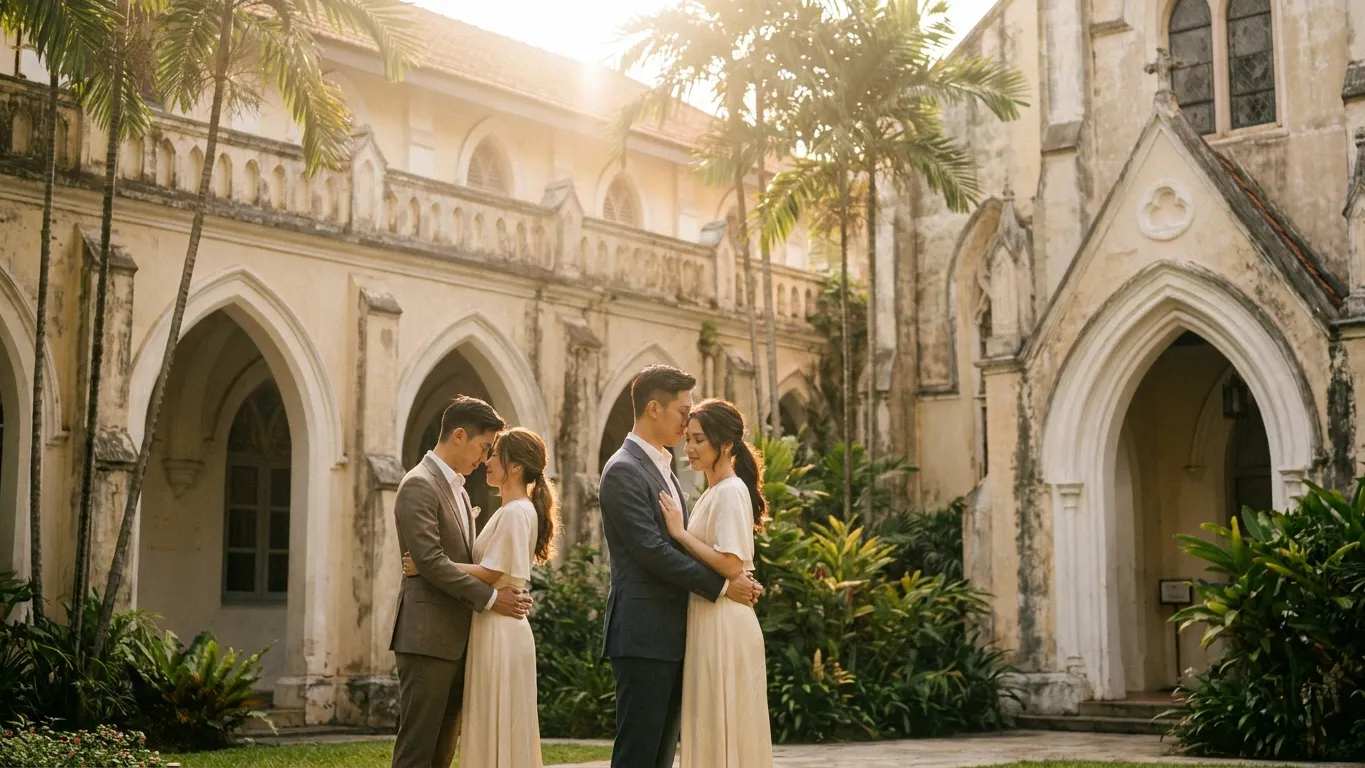
Once the ring conversation is settled, the next major budget item couples face is capturing the actual day. A combined photographer-and-videographer (PGVG) package for the actual day typically ranges from the mid-S$1,000s to S$4,000 or more depending on hours, team size, and edit deliverables. Studios such as The Aurora Wedding offer a PGVG package, covering both actual-day photography and videography, starting from around S$1,988, which can make sense for couples managing multiple wedding budget lines at once. As with diamonds, comparing like-for-like deliverables matters: hours of coverage, number of edited photos, and video length should all be specified before price comparisons mean anything.
---
Certification: What to Ask for Before Paying
Any natural diamond ring above S$3,000 should come with a certificate from a recognised grading laboratory, GIA (Gemological Institute of America) and IGI (International Gemological Institute) are the two most widely accepted in Singapore. The certificate confirms the stone's 4C grades independently of the seller.
For lab-grown diamonds, IGI is the most commonly used certifying body in Singapore. Some local dealers also use GCAL (Gem Certification and Assurance Lab).
Insider tip: every GIA-certified diamond has a laser-inscribed serial number on its girdle (the edge of the stone). Ask the jeweller to verify the inscription under magnification before purchase. The number should match the certificate exactly.
---
Comparison: Key Factors at a Glance

| Factor | What Pushes Price Up | Value Sweet Spot |
|---|---|---|
| Carat | Round numbers (1.0ct, 1.5ct) | Just below: 0.9ct, 1.4ct |
| Cut | Premium for Excellent grade | Excellent cut, non-negotiable |
| Colour | D to F colourless premium | G to H: looks the same |
| Clarity | FL, IF very expensive | VS1 to VS2: eye-clean |
| Shape | Round brilliant costs most | Oval, cushion, emerald cheaper |
| Metal | Platinum most expensive | 18k white gold similar look |
| Source | Brand premium at luxury stores | Local independent saves margin |
| Type | Natural commands premium | Lab-grown: 60 to 80% cheaper |
---
The Shareable Takeaway
The cheapest way to get a bigger-looking diamond ring in Singapore is not to spend more, it is to choose a G-colour, VS2-clarity, oval-cut stone just under the nearest carat threshold, and put the saving into a quality setting. Nobody at the tea ceremony will know, and the ring will be indistinguishable from one costing twice as much.
For the rest of the wedding budget, the same logic applies: match deliverables to your priorities. Couples who lock in both photography and videography under a single PGVG package often find the process simpler and the style more consistent than sourcing both separately.