Note: This article focuses entirely on Singapore couples planning fresh flower bouquets and wedding garlands for their ceremonies. If you arrived here looking for reviews of a specific Coimbatore florist, that falls outside the scope of this Singapore-focused wedding resource.
---
The bouquet is probably the most photographed object at your entire wedding. Not the venue. Not the arch. The bouquet. It appears in almost every key frame: the getting-ready shots, the solemnisation, the gatecrash, the march-in. Yet most couples spend two weeks choosing it and three months agonising over the dessert table. That priority gap is worth fixing.
Fresh flower bouquets and wedding garlands in Singapore sit at the intersection of aesthetics, climate management, cultural tradition, and logistics. Get any one of those wrong and the result shows up in every photo taken that day.
---
What Fresh Flower Bouquets Actually Cost in Singapore
Prices vary more than most couples expect. A bridal bouquet in Singapore generally ranges from around SGD 150 to SGD 500, depending on the flower types, bouquet size, and design complexity. Luxurious or exotic blooms and intricate arrangements push toward the upper end, while classic round posies using roses or baby's breath sit lower. Bridesmaid bouquets typically run SGD 80 to SGD 200 each.
For couples who need the full suite of floral elements, the total spend across bridal bouquet, boutonniere, bridesmaids' posies, and table centrepieces can range from around SGD 1,500 to SGD 5,000 for a mid-sized Singapore wedding. Lavish hotel ballroom affairs with floral arches and elaborate stage backdrops can push well beyond that.
A useful comparison table for Singapore floral budgeting:
| Floral Element | Typical SGD Range |
|---|---|
| Bridal bouquet (fresh) | 150 to 500 |
| Bridal bouquet (preserved) | 120 to 350 |
| Bridesmaid posy | 80 to 200 each |
| Groom boutonniere | 20 to 60 |
| Table centrepiece | 80 to 250 each |
| Floral arch / solemnisation backdrop | 800 to 3,000 |
| Wedding garland set (Indian ceremony) | 150 to 690+ |
| Ceremony aisle florals | 150 to 500 |
Prices above are market ranges based on publicly listed Singapore florist rates and should be verified with individual vendors, as they shift with flower season and supplier costs.
---
Bouquet Styles Popular at Singapore Weddings
Classic Round Posy
The most photographed style in Singapore hotel ballrooms. Tight, dome-shaped, works with almost any gown silhouette. Roses, garden roses, and hydrangeas are the most common choices. Clean enough for ROM photos on the steps of the Registry of Marriages building on Canning Rise, dramatic enough for a Marina Bay banquet backdrop.
Natural / Garden-Style Bouquet
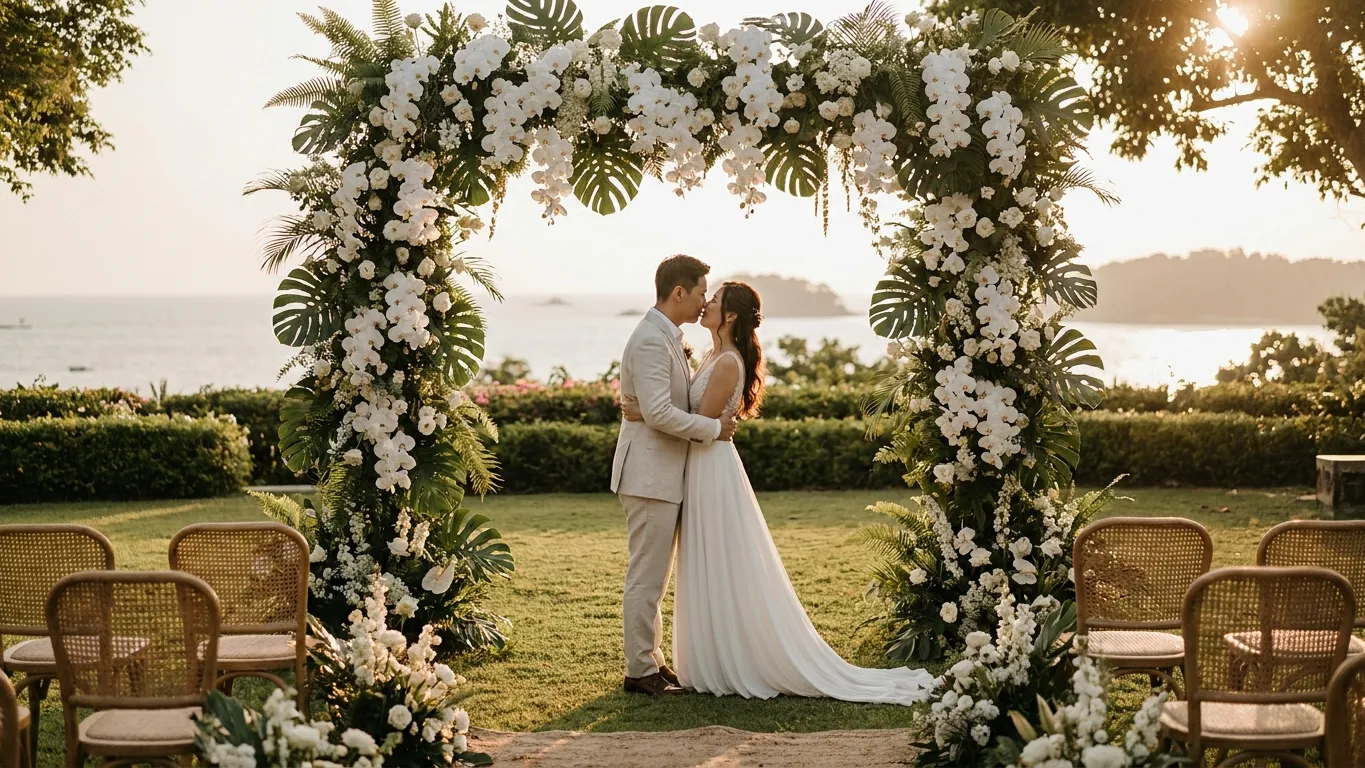
Looser, flowing, with trailing greenery. Popular for Sentosa resort ceremonies and outdoor solemnisations at Botanic Gardens-style settings. Requires a florist who understands how to wire stems for tropical heat, because a loosely arranged bouquet in Singapore's humidity can shift dramatically over a 10-hour day.
Cascading Bouquet
A waterfall of blooms that extends downward. High visual impact, heavier to hold, and tends to look best on taller gowns with clean silhouettes. Suits grand ballrooms at hotels in Orchard or Marina Bay more than HDB void deck setups.
Preserved Flower Bouquet
Not fresh, but worth understanding. Preserved bouquets use real flowers treated to retain colour and form without water. They survive Singapore's humidity reliably and double as a permanent keepsake. Many couples who do a pre-wedding photoshoot choose preserved bouquets precisely because logistics are simpler, no same-day delivery coordination required.
Quotable takeaway: "The bouquet that photographs best is rarely the most expensive one. It is the one that was chosen to complement the gown, the light, and the background, not just the trend."
---
Wedding Garlands in Singapore: Cultural Context

Singapore's multicultural wedding landscape means garlands serve very different roles depending on tradition.
Indian Wedding Garlands (Maalai / Varmala)
For Hindu and South Indian weddings, the maalai maatral, the garland exchange, is one of the most sacred moments in the ceremony. The couple exchanges garlands three times, symbolising mutual acceptance. Friends and family often lift the groom during this exchange, creating one of the most joyful and most photographed sequences of the day.
Fresh jasmine garlands carry particular significance in South Indian tradition: the fragrance is considered auspicious and essential at temple ceremonies. Rose garlands, orchid garlands, and carnation garlands all have their place, with marigold garlands more common for North Indian ceremonies and haldi events.
For a complete Indian wedding garland set covering main garlands, exchange garlands, parents' garlands, a jasmine ball, bouquets, and loose flowers, couples typically budget around SGD 690 for a full set from specialist Singapore florists, with individual pairs starting from around SGD 100 to SGD 200 depending on bloom type.
Insider tip: Order garland sets 2 to 4 weeks in advance during peak Indian wedding season (generally October to March in Singapore, overlapping with Diwali and Tamil New Year adjacent periods). Standard garlands can be ordered 1 to 2 weeks out, but custom designs with rare orchid colours or oversized blooms need longer lead times. Garlands are typically handcrafted on the morning of your wedding and delivered ice-packed to preserve freshness, so confirm your venue access time with the florist before finalising the delivery window.
Malay and Peranakan Weddings
Floral garlands in Malay weddings, known as renjis, tend to be worn differently and serve a ceremonial role during the akad nikah. Fresh flowers remain central to pelamin (wedding dais) decoration, with jasmine, roses, and white blooms common in traditional settings. Peranakan weddings often incorporate elaborate floral arrangements in the Straits Chinese aesthetic, blending tropical blooms with vintage colour palettes.
Chinese and Chinese-Influenced Weddings
Flower usage at Chinese weddings is less garland-focused and more bouquet and centrepiece-driven. Red and pink roses signal prosperity and joy. White flowers carry funeral associations in traditional Chinese custom, so florists experienced in Singapore's Chinese wedding scene will flag this without being asked. Jasmine and orchids are safe choices across all Chinese dialect group customs.
---
Singapore Climate: The Biggest Variable Nobody Plans For
Singapore sits just north of the equator. Average daily temperatures hover around 31 to 33 degrees Celsius outdoors. The northeast monsoon runs roughly November to January, and the southwest monsoon brings rain between June and September, with September to November carrying the heaviest and most unpredictable showers.
What this means for fresh flowers:
- Delivery timing is critical. Florists experienced in the Singapore market pack bouquets in cool, hydrated conditions and time delivery to arrive close to ceremony start. A bouquet sitting in a hot car or direct sun for two hours can look noticeably different by the march-in.
- Outdoor ceremonies need a backup plan. A Saturday afternoon solemnisation in a Sentosa garden or Botanic Gardens setting should always have an indoor fallback identified by Week 16 of planning, not the night before.
- Air-conditioned hotel ballrooms extend flower life. The dim, cool environment inside most Orchard and Marina Bay banquet venues is actually ideal for fresh flowers. The problem is the gap between morning setup and evening dinner, sometimes six hours or more, during which flowers should remain refrigerated or at least in a cool, shaded space.
- Preserved flowers solve the logistics headache. For outdoor shoots, day-long actual day packages, or Bali pre-wedding photoshoots, many couples opt for preserved bouquets for the extended shoot and keep fresh blooms for the ceremony itself.
Insider tip: At the ROM Registry of Marriages on Canning Rise, solemnisations are typically brisk, often 20 to 30 minutes. The building is fully air-conditioned. A fresh bouquet will hold perfectly for an indoor ROM. The challenge is the outdoor photo session immediately after on the steps, especially on a midday Saturday. A bouquet delivered fresh that morning, kept chilled until departure, and carried out only for the photos will look far better than one that has been in the couple's hands since 8am.
---
How to Choose Between Fresh, Preserved, and Silk Flowers

| Factor | Fresh | Preserved | Silk |
|---|---|---|---|
| Fragrance | Yes | Faint | None |
| Lifespan on the day | 6 to 12 hours | Indefinite | Indefinite |
| Keepsake value | Low (wilts) | High | High |
| Singapore humidity tolerance | Moderate | High | Very high |
| Photo quality | Soft, natural | Natural tones | Can look flat |
| Cost | Medium | Medium to high | Low to medium |
| Lead time needed | 1 to 2 weeks | 2 to 4 weeks | Flexible |
A practical middle path: use fresh flowers for the bridal bouquet and garlands (these appear most prominently in photos and ceremony footage), and preserved or silk options for bridesmaid posies, car decoration, and table centrepieces that receive less close-up attention.
---
Bouquets as Part of an all-in-one package
Some Singapore couples prefer to source their bridal bouquet through the same studio handling photography and makeup, simply to reduce the number of vendors they are coordinating. The Aurora Wedding, for instance, offers handcrafted fresh and preserved bouquets from around SGD 180, with more than 55 designs available and a complimentary boutonniere included. Pairing the bridal bouquet with a PGVG package or a full actual day package means the photographer already knows the bouquet style before arrival on the day, which helps with shot framing and colour grading decisions. Couples who handle florals separately sometimes find the photographer is seeing the bouquet for the first time on the wedding morning, which is a minor but real inefficiency.
For a pre-wedding photography session, especially a Bali pre-wedding shoot, co-ordinating the bouquet style with the studio in advance is even more useful, since tropical outdoor light and lush backgrounds reward intentional colour choices in the blooms.
---
Planning Checklist: Fresh Flower Bouquets and Garlands

| Stage | Timeline Before Wedding |
|---|---|
| Confirm style and colour palette with florist | 3 to 6 months out |
| Book florist and pay deposit | 3 to 4 months out |
| Share final gown photos with florist | 6 to 8 weeks out |
| Confirm Indian garland set (custom designs) | 4 weeks out |
| Confirm standard garland orders | 1 to 2 weeks out |
| Confirm delivery address and venue access time | 1 week out |
| Assign a bridesmaid to manage bouquet care on the day | Wedding morning |
| Keep bouquet away from direct sun and hot car interiors | Throughout the day |
---
What to Ask Any Singapore Florist Before Booking
- Can you show me examples of work in a similar colour palette to mine?
- What flowers do you recommend for Singapore's climate and an outdoor ceremony?
- Is the bouquet delivered on the morning, and how is it packaged for transport?
- Do you coordinate directly with the venue for garland or arch delivery access?
- What happens if a specific flower is unavailable due to supply issues on the week of the wedding?
- Is the boutonniere included, or priced separately?
A florist who hesitates on question 5 is worth noting. Supply chain disruptions are real, particularly for imported blooms, and a florist without a clear substitution plan is a risk on the most important day of the year.
---
The best wedding floral decisions are usually invisible on the day: the bouquet that did not wilt, the garland that held its fragrance through the maalai maatral, the centrepiece that did not block the conversation across the table. Couples who shortlist The Aurora Wedding for a bundled photography and bouquet package, or who find a dedicated Singapore florist with genuine local experience in multi-cultural ceremonies, tend to share one thing in common. They planned the flowers with the same care they gave the guest list, not as an afterthought on the final checklist.
Screenshot-worthy takeaway: The bouquet that photographs best is the one chosen in conversation with your photographer, not selected in isolation the week before the wedding.