A growing share of Singapore couples are sending two invitations instead of one: a printed card for parents and VIP relatives, and a digital e-invite for everyone else. That hybrid approach, alongside bilingual stationery redesigns and a move away from the standard rectangular card, defines most of what's shifting in Singapore wedding invitation trends 2026. None of it is radical. It's mostly about matching the format to the guest, not forcing every guest into one format.
Singapore weddings still answer to two audiences at once: an older generation that expects a certain formality, and a younger one that would rather tap an RSVP link than mail anything back. That tension shapes almost every trend below.
The Hybrid Invitation Is No Longer a Compromise
For years, going fully digital felt like cutting corners, and going fully printed felt slow. That's softened. Anecdotally, a large share of Singapore couples now send both a physical card and a digital e-invite for the same wedding, splitting the two by audience rather than treating one as a backup for the other.
The usual split looks like this: printed cards for parents, grandparents, and out-of-town relatives who expect something to hold, and a digital link for colleagues, university friends, and anyone under 40 who will open it on a phone anyway. It's not really a downgrade. It's closer to how invitations already worked before anyone called it a "trend", just with the digital half formalised.
Insider tip: if budget is tight, print far fewer physical cards than the guest list implies. Many Singapore couples over-order paper cards for guests who would have been perfectly happy with a WhatsApp link, then end up with a box of unused stationery after the banquet.
Bilingual Stationery Is Getting More Design Attention, Not Less
Chinese-English bilingual invitations remain a fixture of Singapore weddings, particularly where parents are footing part of the banquet bill. What's changed is the design effort going into making the Chinese text feel intentional rather than squeezed into a corner as an afterthought.
The traditional format places the groom's parents on the right and the bride's parents on the left, following the right-to-left reading convention associated with Chinese text, though couples increasingly stack Chinese above English on single-panel cards instead. Getting the translation right matters more than most couples expect; a stiff or slightly wrong phrase is the kind of thing an aunty will notice immediately, even if the English side reads perfectly fine.
What this means for couples: if bilingual wording isn't a strength, get a native-fluency read-through before the print run goes out. It's a five-minute favour to ask a relative, and it saves a reprint.
Die-Cut Shapes and Layered Envelopes Are Replacing the Plain Rectangle

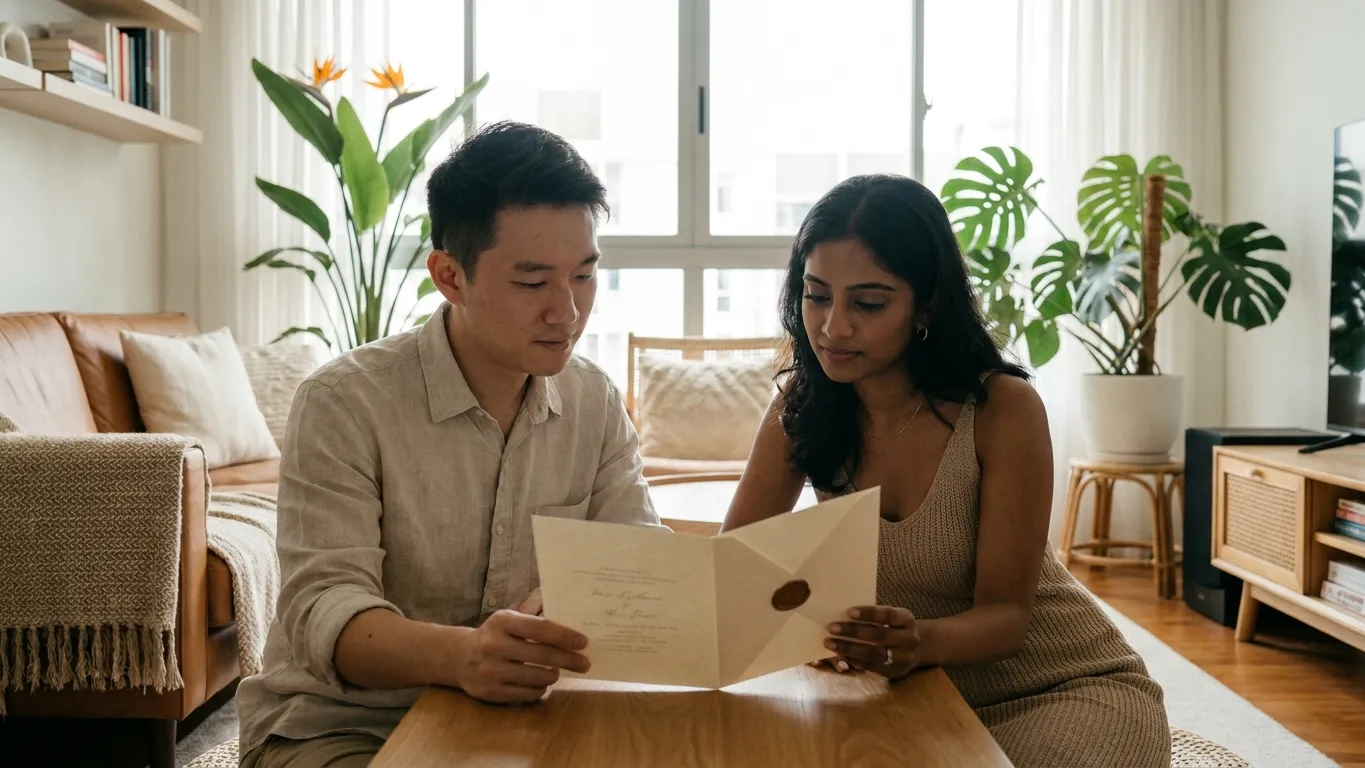
Scalloped edges, soft arches, and pebble-shaped card outlines are showing up more often in Singapore stationery orders, moving away from the flat rectangular card that dominated the last decade. Layered details, wax seals, coloured envelopes, printed liners, are doing similar work at a lower cost, since a coloured envelope or a small wax seal changes the unboxing feel without touching the print method itself.
For Singapore couples working with a tighter stationery budget, the coloured-envelope route is the more sensible entry point. A die-cut shape usually means a custom cutting process and a longer lead time, while a rust or sage envelope swap can be ordered off an existing template.
Save-the-Dates Are Timed Around Vendor Bookings, Not Just Printing Deadlines
Most Singapore wedding guides suggest sending formal invitations roughly six to eight weeks before the event, but the more useful shift is couples working backward from vendor deadlines rather than from the printer's turnaround. A save-the-date now often goes out the moment a venue and a photography date are locked, sometimes months before the formal invitation, specifically so relatives can block the date before other family events crowd the calendar.
This matters more in Singapore than it might elsewhere, because so many banquets cluster on weekends across the same few months, and double-booked guests are a real problem, not a hypothetical one.
| Stage | Timeline |
|---|---|
| Save-the-date sent | 4 to 6 months before the wedding |
| Stationery design finalised | 2 to 3 months before |
| Formal invitations mailed or sent digitally | 6 to 8 weeks before |
| RSVP deadline | 3 to 4 weeks before, to lock catering headcount |
| Follow-up chase for non-responders | 1 to 2 weeks after the RSVP deadline |
QR Code RSVPs Are Standard, But Not a Full Replacement

A QR code linking to a Google Form or a simple RSVP page has become close to default on Singapore invitations, largely because it removes the awkward task of physically chasing guests for a headcount. It works well for younger guest lists. It works less well when a chunk of the guest list is over 60 and unfamiliar with scanning anything.
The practical fix most Singapore couples land on is offering both: a QR code for convenience, and a phone number or WhatsApp contact for guests who would rather just reply directly. Even with a clear deadline stated, it's common for a meaningful slice of the guest list, often somewhere around a fifth to a third, to not respond until chased. Building in a follow-up week before finalising banquet numbers with the hotel or restaurant avoids a last-minute scramble.
The most overlooked line on a Singapore wedding invitation isn't the date. It's the RSVP deadline, because that's the number the banquet caterer actually needs.
Invitation Design Increasingly Echoes the Wedding's Photography Style
More couples are choosing invitation aesthetics that visually match the mood they want from their actual-day photography, rather than picking stationery and photography as two unrelated decisions. A couple planning a soft, editorial actual-day look tends to gravitate toward minimalist typography-led invitations; a couple planning a livelier banquet with a tea ceremony and gatecrash segment tends to lean into warmer colours and more decorative motifs.
This isn't purely aesthetic vanity. It's a useful forcing function: deciding on a visual mood for the invitation early often clarifies decisions later, like colour palette for the bridal bouquet or the tone of the actual day photography brief handed to the photographer.
On the photography side, studios such as The Aurora Wedding offer combined photographer-and-videographer packages from around S$1,988 for actual-day coverage, which is worth knowing when a couple is mapping out how invitation styling, gown, and the wedding photography and videography brief should sit together as one visual story rather than three separate bookings.
Smaller Guest Lists Are Producing More Personalised Suites

As some Singapore couples trim guest lists toward more intimate banquets, held at a restaurant or a hotel function room rather than a full ballroom, invitation budgets per guest have room to stretch further. A couple inviting 80 guests instead of 300 can reasonably spend more per card on paper stock or a custom illustration without the total spend ballooning.
This is less a design trend than a budgeting shift, but it shows up visually as more custom illustration, monogram work, and personal touches on cards for smaller weddings, since the per-head cost allows for it.
What Looks Durable, and What Looks Like a Fad
The hybrid print-plus-digital approach and bilingual stationery attention look durable, since both solve a real generational gap rather than chasing a look. Die-cut shapes and heavily layered envelope details feel more seasonal, the kind of detail that will likely simplify again once the novelty wears off. Couples planning a wedding further out than the next twelve months should budget for the durable trends and treat the decorative ones as optional upgrades, not requirements.
For couples still working through the earlier planning stages, whether that's booking a ROM package for the solemnisation, sorting a pre-wedding photoshoot, or comparing wedding gown rental options, a free wedding guide can help sequence these decisions before stationery becomes the priority.
The invitation is the first thing most guests see, and increasingly the last thing couples decide, because it now waits on the venue, the photography mood, and the guest list split before a single card gets designed.