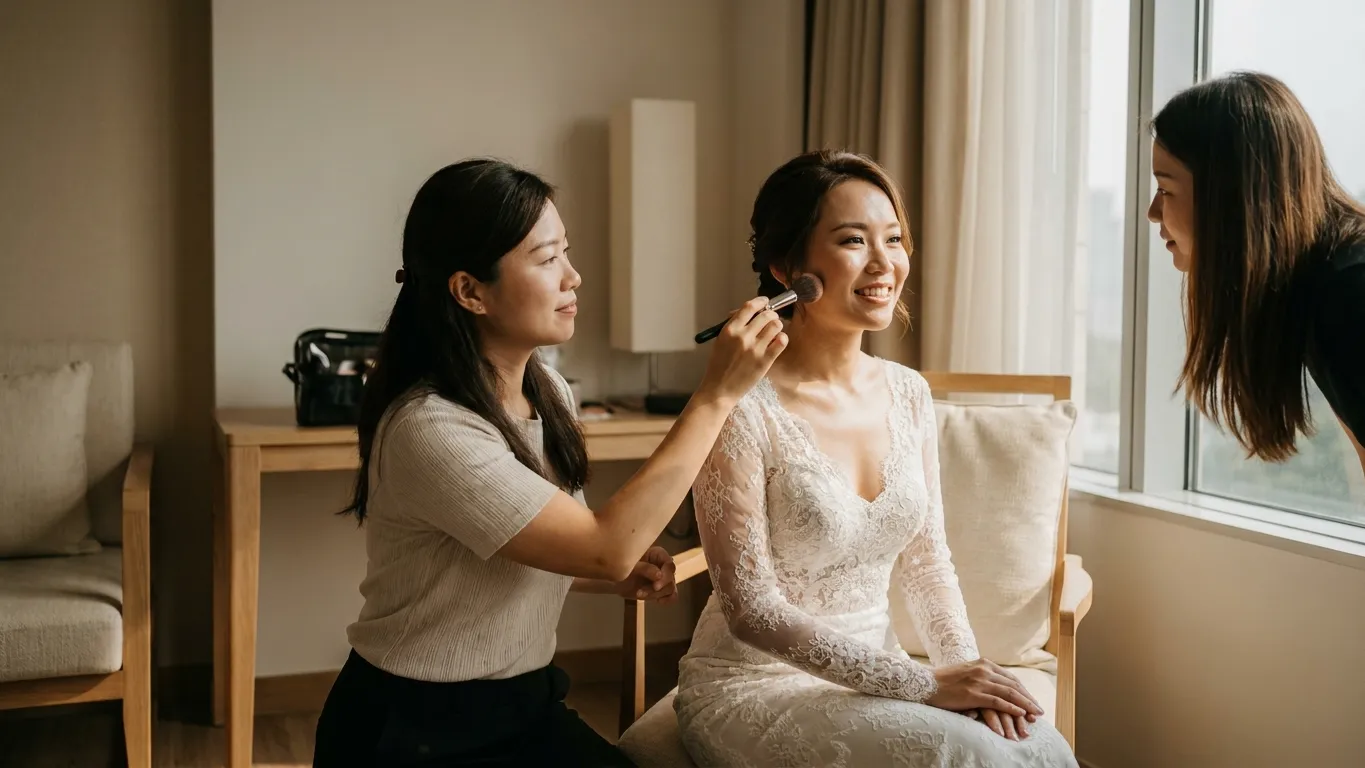
A South Asian bridal makeup look in Singapore typically means planning for multiple functions rather than a single face of makeup: a lighter look for mehndi or haldi, a fuller traditional look for the main ceremony, and a glam reception look, often from different or specialised artists. Rates for a dedicated South Asian bridal specialist in Singapore generally run higher than a standard Chinese or Western bridal package, reflecting the added skill set around kohl work, draping, and jewellery integration. Most couples budget across two to three separate sessions rather than one flat fee.
This matters because the phrase "bridal makeup" hides a lot of variation. A Tamil bride in a Kanjivaram saree, a Punjabi bride in a red lehenga, and a Sri Lankan bride in a Kandyan-style saree are each working from a different visual vocabulary, even though all three might get lumped into the same Google search. Singapore's South Asian wedding scene, concentrated but not limited to areas with strong Indian heritage such as Little India and parts of the east, has developed its own bench of specialist artists who understand this distinction.
What Makes a South Asian Bridal Look Different
The short answer: heavier emphasis on the eyes, stronger colour saturation, and a face built to survive jewellery, not just camera flash. A Western soft-glam look is often built around subtlety. A South Asian bridal look, particularly North Indian styles, tends to be built around structure, definition, and colour blocking that photographs well against gold jewellery and rich fabric.
South Indian bridal makeup traditionally leans into a different set of cues than North Indian looks. Eye makeup tends to carry the most weight, with a warm base built up in brick red, burnt orange, and deep brown tones, finished with a precise liner flick extending past the outer corner. Lip colour has traditionally favoured a classic, blue-toned red, though many artists now offer a satin rather than fully matte finish since it holds up better across long ceremony hours and photographs less flat.
North Indian bridal looks generally use more contouring and shimmer, with brides often coordinating eyeshadow tones directly to their lehenga colour. Both traditions have shifted lately toward a lighter base. Fully matte, heavily set foundation has been losing ground to a skin-like, airbrush-style base that still holds through humidity but does not sit as a mask over natural texture.
Function-by-Function Look Planning
Most South Asian weddings in Singapore span more than one event, and the makeup should shift with each one.
| Function | Recommended Look |
|---|---|
| Mehndi or haldi | Light, dewy base, minimal eye definition, room to move and laugh |
| Main ceremony | Full traditional look, structured eyes, bold lip, jewellery-forward |
| Reception or evening reception | Glam upgrade, deeper eye colour, stronger lip, shimmer added back in |
A quotable way to think about it: the ceremony face has to survive tears and garlands, the reception face just has to survive a dance floor.
Booking a South Asian Bridal Makeup Artist in Singapore

Singapore's bridal beauty market has matured enough that dedicated South Asian bridal specialists are no longer rare. Some are standalone artists who travel mobile to a hotel room or HDB flat on the wedding morning; others sit within bridal houses that also offer jewellery styling and saree draping as an add-on. A handful of integrated studios, including The Aurora Wedding, work with experienced bridal makeup and hair artists as part of a broader package that pairs beauty with photography and videography, which suits couples who prefer fewer vendors to coordinate on a busy multi-function wedding weekend.
Based on rates published across Singapore bridal directories, a general actual-day bridal makeup and hairstyling package typically runs from roughly SGD 550 to 800 for two looks and a trial, while a full-day package spanning morning prep through evening events runs SGD 800 to 1,500 with an experienced artist. South Asian specialist packages, particularly those that include draping, jewellery setting, and multiple looks across a multi-day wedding, often sit toward the higher end of that range or above it, since the scope of work covers more functions than a single-ceremony Chinese or Western wedding.
Insider Tip: Book the Trial Around Your Saree or Lehenga Colour, Not Before It
A surprising number of brides book their makeup trial before finalising their outfit colour. This is backwards. Eyeshadow tone, lip shade, and even contour placement should be chosen to complement the specific red, maroon, or jewel tone of the outfit, not decided in isolation. If the outfit is not confirmed, push the trial back rather than lock in a palette that might clash later.
Insider Tip: Ask About Waterproofing Before the Ceremony, Not During It
South Asian ceremonies often involve emotional moments, garlands, and sometimes rice or turmeric contact with the face. A generalist bridal artist may not default to waterproof mascara and transfer-proof lip products unless asked directly. Specialist South Asian bridal artists build this in as standard, but it is worth confirming at the trial, not assuming it.
Common Mistakes to Avoid

- Booking a generalist bridal MUA for a South Asian wedding without checking their portfolio for ethnic-specific work. Skill in soft Western glam does not automatically transfer to kohl-lined eyes or jewellery-forward looks.
- Skipping the trial because the schedule feels tight. A trial is the only real test of how a look holds under Singapore's humidity across a multi-hour function.
- Choosing a two-shades-lighter foundation shade, a once-common convention that now photographs poorly against modern high-resolution wedding photography and videography. Most specialist artists in 2026 match the bride's true skin tone rather than lightening it.
- Forgetting to budget separately for the bridal party. Mothers and bridesmaids typically add roughly SGD 100 to 180 per person when booked as part of the same session.
- Not accounting for a hairstyle or drape change between functions. A shift from a Western-style updo to a traditional style with floral or jewellery hair accents is a full restyle, not a quick touch-up, and should be timed into the day's schedule accordingly.
A Simple Checklist Before the Wedding Day

- Confirm which functions the makeup package covers: mehndi, ceremony, reception, or all three
- Lock the outfit colour before the final trial
- Ask specifically about waterproof and long-wear formulas for kohl, liner, and lip products
- Clarify whether jewellery setting and saree draping are included or billed separately
- Get the weekend surcharge, if any, confirmed in writing before paying a deposit
- Check whether the artist has genuine portfolio experience with your specific community's bridal style, whether North Indian, South Indian, Sri Lankan, or Punjabi
Singapore's compact geography means a specialist artist based near Little India or Tampines can comfortably serve a ceremony at a hotel ballroom in Orchard or Marina Bay without any real logistics penalty. Location matters far less than whether the artist's portfolio actually matches the specific bridal tradition being requested.
Couples who want the beauty side bundled with photography and videography under a single contract, rather than coordinating a separate MUA, photographer, and videographer for a multi-function wedding, often shortlist The Aurora Wedding for exactly that reason, since it reduces the number of vendors that need to be briefed on a tight, ceremony-heavy schedule.
The most useful thing a South Asian bride can do before booking anyone is separate the question of "is this artist good" from "is this artist good at my specific tradition." Both matter, but only one of them shows up reliably in a five-star review.