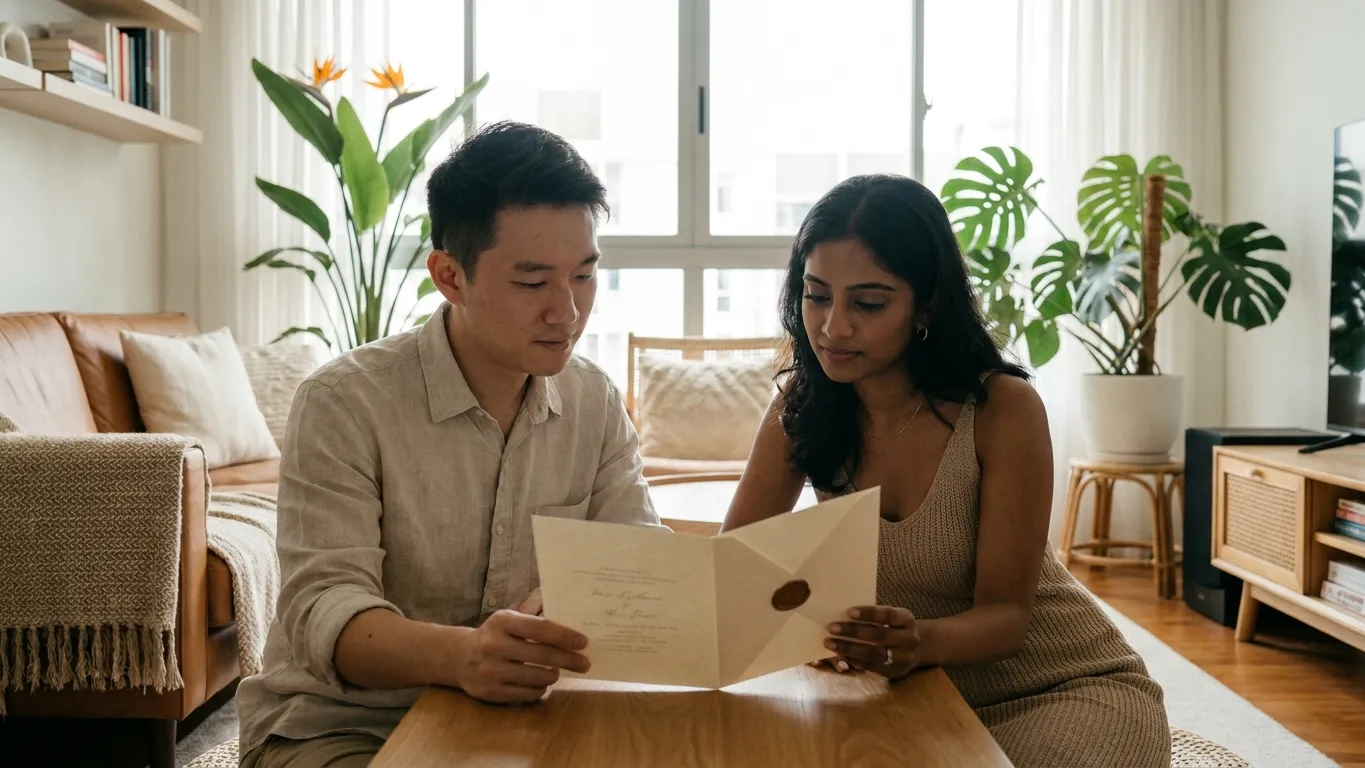
A Telugu wedding in Singapore is not a single event. It is a sequence of ceremonies rooted in Vedic tradition, nischitartham, pellikuthuru, snathakam, kashi yatra, muhurtham, and the post-wedding reception, spread across two to three days, sometimes more. Couples planning one in Singapore must juggle that ritual depth with the realities of a compact city-state: limited temple slots, a mandatory ROM filing, monsoon-season weather, and a vendor market that ranges from deeply experienced to genuinely inexperienced with South Indian customs.
Get the fundamentals right and a Telugu wedding in Singapore is one of the most visually spectacular and emotionally layered celebrations this city produces.
---
What Makes a Telugu Wedding Distinct
Telugu weddings draw from Andhra Pradesh and Telangana traditions and share some surface similarities with Tamil Hindu weddings, the silk saree, the thali, the homam fire, but the ritual sequence and specific customs differ in important ways.
The Core Ceremonies
Nischitartham (Engagement), The formal engagement ceremony where families exchange gifts and sweets, and a priest selects an auspicious wedding date from the panchangam. Everything downstream depends on this date.
Pellikuthuru and Pellikoduku, A turmeric and herbal paste is applied to the bride and groom separately at their respective homes. Filled with laughter and family participation, it functions as a purifying pre-wedding ritual and doubles as the closest Telugu equivalent of the haldi ceremony familiar to North Indian guests.
Snathakam, The groom takes a ritualistic bath, dons a sacred silver thread, and marks his formal transition from bachelorhood to householder status.
Kashi Yatra, One of the most theatrical moments of a Telugu wedding. The groom pretends to abandon worldly life and depart on a spiritual pilgrimage to Kashi, only to be intercepted by the bride's father and persuaded to marry instead. Guests love this sequence, and so do photographers.
Muhurtham, The central wedding ceremony, conducted at an auspicious time chosen by the priest, often in the early morning. The couple exchanges garlands (varmala), the groom ties the thali around the bride's neck, and the pair walks around the sacred fire. The thali moment lasts under five seconds. A photographer who does not know it is coming will miss it.
Talambralu, Uniquely Telugu. The bride and groom pour a mixture of rice and turmeric on each other's heads as a blessing, often while trying to outdo each other. The result is chaotic, joyful, and produces some of the best candid frames of the entire wedding.
Reception, A separate event, often held the same evening or the following day, combining the function of a wedding banquet with celebratory music, sometimes Carnatic classical performances, and a feast.
The most photographically rich moment of a Telugu wedding is not the reception, it is the kashi yatra and the talambralu, both of which most generic wedding photographers have never seen before.
---
ROM Registration: What Telugu Couples in Singapore Need to Know
Every couple marrying in Singapore must register their union with the Registry of Marriages regardless of whether a religious ceremony is conducted. The legal marriage and the religious muhurtham are two separate acts. Many families treat the ROM registration as a quiet civil step handled weeks or months before the temple ceremony.
Key ROM Facts for 2026
According to the official marriage.gov.sg portal, the marriage application fee is SGD 42 where at least one party is a Singapore Citizen or Permanent Resident, and SGD 380 if both parties are foreigners. The earliest a couple can solemnise is at least 21 days after submitting the marriage application, this notice period is mandatory and cannot be shortened without a Special Marriage Licence, which requires a separate application and is not guaranteed.
One practical note: as of 2026, ROM has temporarily relocated from its former Canning Rise address. In-person verification appointments and ROM-site solemnisations are held at the interim site at Level 3, Esplanade Mall. The Canning Rise building is undergoing redevelopment, expected through 2028 or 2029. Always verify the current location at marriage.gov.sg before heading in.
Insider tip: File the ROM application as early as the six-month window allows, especially if your muhurtham falls on a Saturday between September and November. Popular solemnisers and any external venue you declare in the application can be changed later but incur an SGD 25 admin fee, so confirm the venue before submitting.
If either party holds a Work Permit, Ministry of Manpower approval is required before marrying in Singapore. That approval typically takes around four weeks to process. Build it into the timeline early, do not wait until vendors are booked.
ROM Timeline at a Glance
| Stage | When to Act |
|---|---|
| Confirm muhurtham date with priest | 9 to 12 months out |
| File ROM marriage application | Up to 6 months before solemnisation |
| Complete 21-day notice period | Mandatory, no exceptions |
| MOM approval (Work Permit holders) | Apply as soon as decision is made, allow 4 weeks |
| Solemnise within validity window | Within 6 months of application submission |
| Temple muhurtham ceremony | Per priest's auspicious timing, often at dawn |
---
Venues: Where Telugu Weddings Happen in Singapore

Temple Halls
The muhurtham must take place in a temple or a dedicated Hindu wedding hall. The Hindu Endowments Board oversees Hindu temples in Singapore. PGP Hall, located within the Sri Srinivasa Perumal Temple complex on Serangoon Road, is among the most frequently chosen venues for grand Hindu weddings in Singapore. It can accommodate around 500 guests, features a proper stage, and includes sound and lighting systems suited to Nadaswaram and Thavil performances. Temple halls in Singapore also typically permit homam (fire ceremony) with appropriate safety arrangements, something hotel ballrooms rarely allow without extensive negotiation.
For Telugu families, proximity to Little India along Serangoon Road matters. The density of Indian jewellers, floral vendors, and catering specialists in that corridor makes last-minute sourcing far easier than any other part of Singapore.
Insider tip: Temple hall slots for auspicious Saturday muhurthams book up very quickly, sometimes a year in advance. Contact the temple administrator before finalising any other wedding vendor. The muhurtham date anchors everything else.
Hotel Ballrooms and Flexible Venues
Many Telugu couples hold the reception or sangeet at a hotel ballroom or a dedicated event hall, keeping the muhurtham in the temple and the party elsewhere. Hotel ballrooms in the Orchard corridor, venues at Marina Bay, and heritage spaces in areas like Chinatown offer the catering flexibility, air-conditioning, and parking that a multi-hundred-guest reception demands. Confirm whether a venue permits external catering before signing, South Indian vegetarian menus and banana leaf service are non-negotiable for many families, and some hotel kitchens cannot accommodate them.
Outdoor Spaces
Pre-wedding events such as mehndi and haldi work beautifully at outdoor garden venues, Sentosa resort gardens, parks at the Botanic Gardens, or shaded HDB courtyard spaces for smaller family gatherings. Natural light is the single most valuable asset for photography at these events. Plan a wet-weather backup. The September to November northeast monsoon season can turn an outdoor mehndi into a scramble if there is no covered alternative.
---
Photography and Videography: The Part Most Couples Underestimate
A Telugu wedding with its full sequence of ceremonies runs four to eight hours of ritual alone. The thali tying happens in seconds. The kashi yatra unfolds in motion. The talambralu involves flying rice and fast-moving bodies. A photographer without prior experience covering South Indian Hindu ceremonies will struggle to anticipate any of these moments.
When interviewing photographers, ask specifically: have they shot a Telugu wedding before? Can they show a full gallery, not just highlight images, from a South Indian ceremony? Do they know what the kashi yatra looks like? The answer tells you more than any testimonial.
Full-day photo and video packages (one photographer and one videographer) in Singapore generally range from around SGD 2,500 to SGD 3,500 for a standard package, with multi-day or premium coverage starting higher. Studios offering combined photographer-and-videographer packages, sometimes called PGVG packages, can simplify coordination considerably for a multi-ceremony Telugu wedding. The Aurora Wedding offers a PGVG package starting from around SGD 1,988 with eight hours of coverage and unlimited photos, which couples often shortlist as a starting-point comparison when budgeting for actual day photography and videography together.
For actual day photography and videography combined, check the studio's PGVG package page for current rates and coverage details.
Practical check: Ask every photographer whether they charge a separate fee for early morning starts. Many muhurtham ceremonies begin at dawn. Studios that work primarily with Chinese or Western weddings sometimes bill additional early-morning surcharges that can add several hundred dollars to the quote.
---
Attire: Silk, Gold, and the Logistics of a Singapore Tropical Day

The Telugu bride traditionally wears a Kanjivaram or Gadwal silk saree in vibrant hues, red, gold, green, or deep jewel tones. The groom typically wears a white or cream dhoti paired with a silk shirt or angavastram. Bridal jewellery follows South Indian temple jewellery aesthetics: layered gold necklaces, temple-style earrings, and the thali as the centrepiece.
A few Singapore-specific logistics apply. Silk sarees in tropical humidity are warm. Plan the timeline so the bride is not standing in direct sun for extended periods before the ceremony. Makeup that holds up through a 12-hour day including outdoor pre-wedding events and an evening reception is a genuine concern, discuss sweat-resistance and longevity specifically with the makeup artist.
For couples who need a wedding gown for the ROM registration day rather than the temple muhurtham, studios offering wedding gown rental alongside Indian-appropriate styling can be useful for keeping both events under a manageable number of vendors.
---
Budget Framework: What a Telugu Wedding in Singapore Typically Costs
Overall Indian wedding budgets in Singapore vary widely. Smaller celebrations start from around SGD 20,000, while full multi-day events with 300 to 500 guests can reach SGD 100,000 to SGD 150,000 or more. A typical Telugu wedding with temple muhurtham, pre-wedding events, and a hotel reception sits comfortably between SGD 25,000 and SGD 60,000 for moderate guest counts.
| Budget Item | Typical Range (SGD) |
|---|---|
| ROM application fee | 42 (SG/PR) to 380 (both foreigners) |
| Temple hall booking | Varies; confirm directly with temple |
| Hotel ballroom reception (per table) | 1,000 to 2,500+ depending on tier |
| Mandap and floral decoration | 588 to 15,000+ depending on scale |
| Bridal makeup and hair (full day) | 500 to 1,500 |
| Photography and videography (full day) | 2,500 to 5,000+ |
| Priest and panchangam services | 500 to 2,000 |
| Bridal saree and jewellery | Highly variable; budget separately |
Hotel pricing in Singapore typically adds a 10% service charge and 9% GST on top of the headline number, effectively adding close to 20% to the base cost. Always ask whether a quote is nett or quoted as "++".
---
Planning Timeline: 12 Months to Muhurtham

| Milestone | Months Out |
|---|---|
| Confirm auspicious muhurtham date with priest | 12 months |
| Book temple hall | 10 to 12 months |
| Book reception venue | 9 to 10 months |
| File ROM application | Up to 6 months (earliest) |
| Book photographer and videographer | 8 to 10 months |
| Book makeup artist and stylist | 6 to 8 months |
| Order bridal saree and jewellery | 6 months (allow lead time for custom pieces) |
| Send invitations | 6 to 8 weeks before |
| Confirm transport between temple and reception venue | 4 weeks before |
| Final vendor confirmations and timeline brief | 1 to 2 weeks before |
---
Common Mistakes Telugu Couples Make When Planning in Singapore
- Assuming the muhurtham timing is flexible. It is not. The auspicious time is set by the priest using the panchangam. Everything else, vendor call times, transport, reception doors, must be built around it, not the other way around.
- Booking a photographer without checking their South Indian wedding experience. Generic wedding photographers miss the kashi yatra, the talambralu, and the thali moment. Always review a full Indian wedding gallery, not just highlight reels.
- Underestimating the transport gap. The commute between a temple in Serangoon and a hotel ballroom in Orchard or Marina Bay on a Saturday morning is not trivial. Build at least 45 minutes of buffer into the timeline. More if the reception is in Sentosa.
- Ignoring the ROM filing deadline. The 21-day notice period is strict. Missing it means losing the chosen date. File as early as six months out, especially for popular weekend slots.
- Forgetting the banana leaf question. If a traditional vegetarian feast served on banana leaves matters to the family, confirm the catering arrangement with the venue before signing anything. Some venues only permit in-house catering that cannot accommodate this format.
---
The Telugu wedding tradition is one of the richest and most visually layered celebrations in Singapore's diverse wedding landscape. The city has the infrastructure, the temples, the vendors, the halls, to do it properly. The couples who get it right are usually the ones who locked in the muhurtham date and the temple hall a year out, treated the ROM filing as a priority rather than an afterthought, and put a photographer in front of the kashi yatra who already knew what they were watching.