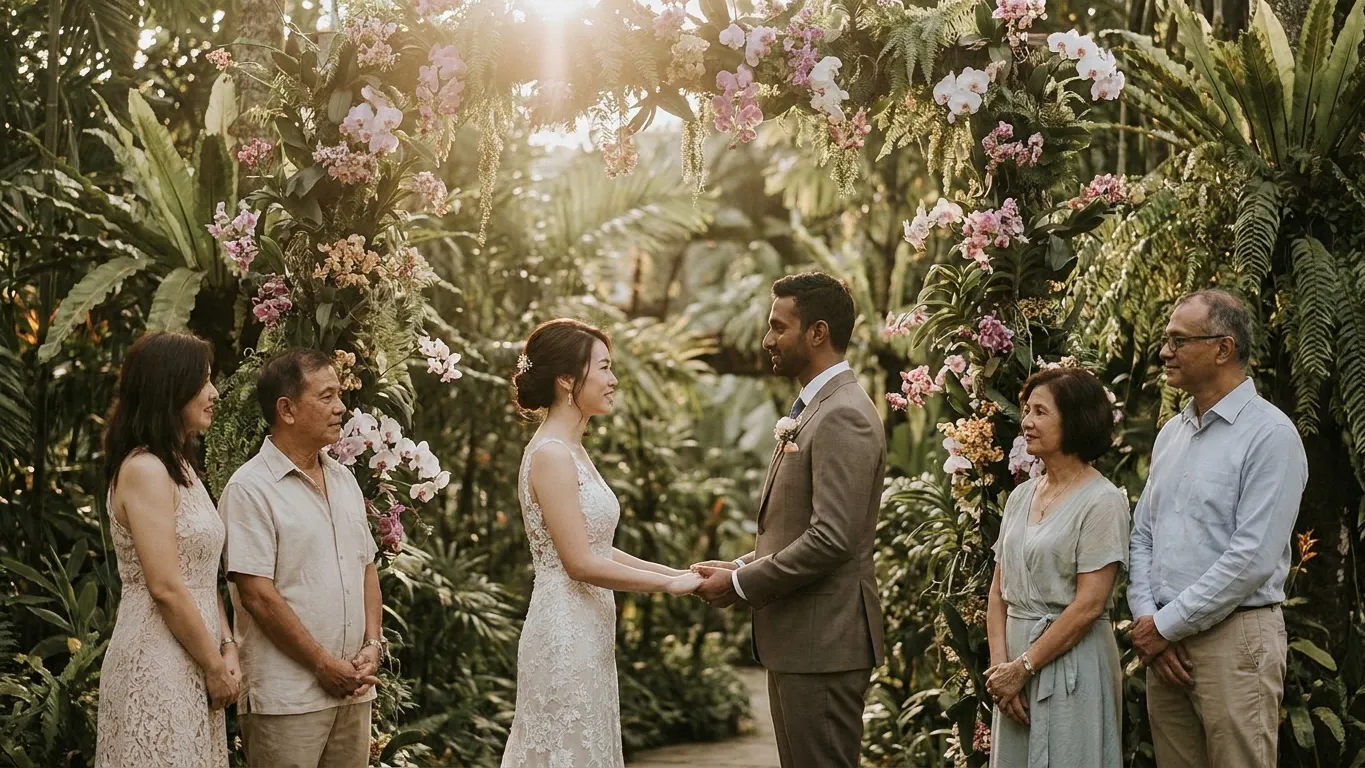
The signatures are done, the certificate is on your Singpass dashboard, and the solemniser has left the room. You are legally married. For many Singapore couples, the ROM ceremony itself lasts around 15 to 30 minutes - which means the rest of the day, and the months ahead, are entirely yours to shape.
The top 5 things to do after ROM in Singapore are: celebrate with an intimate meal, book a pre-wedding photoshoot, sort out your administrative updates, plan your customary wedding or banquet, and enjoy a mini-honeymoon or couple getaway. Each step builds on the last, and handling them in roughly this order keeps the momentum without the overwhelm.
The most expensive mistake after ROM is waiting too long to book your pre-wedding photographer. Popular teams fill up 9 to 12 months ahead.
---
1. Celebrate Intimately With Both Families
The ROM ceremony is legally the wedding. Everything else - the tea ceremony, the banquet, the gatecrash - is tradition and celebration layered on top. So treat this day as a proper occasion worth marking.
Most couples keep the post-ROM celebration small: a sit-down lunch or dinner with immediate family on both sides, typically 10 to 30 people. A private dining room in a hotel along Orchard Road, a heritage restaurant in Chinatown, or even a reserved section of a beloved hawker spot in Tiong Bahru all work well. The intimacy is the point. This is not the grand banquet - that comes later - so the pressure is lower and the conversation tends to be more genuine.
Insider tip: Weekday ROM slots, particularly Tuesday to Thursday mornings, generally free up the afternoon for a relaxed family lunch without fighting Saturday restaurant crowds. If your ceremony finishes by noon, a 1pm reservation at a private dining room is very achievable.
For couples who choose to keep the entire celebration at this scale - skipping the banquet entirely - the ROM lunch or dinner becomes the centrepiece. This approach, sometimes called a "micro ROM", is becoming more common among couples who would rather channel savings into their BTO renovation or a longer honeymoon.
---
2. Book Your Pre-Wedding Photoshoot Promptly

The ROM certificate is issued, the day is still fresh in memory, and the two of you are in a rare window of low-stress, pre-banquet calm. This is exactly the right moment to confirm your pre-wedding photoshoot.
A pre-wedding photoshoot serves several practical purposes beyond the obvious. The images go on your banquet screens, your wedding invitations, your photo displays, and your first social announcement as a married couple. Leaving the booking too late compresses every downstream deadline.
Singapore offers an enormous variety of backdrops in a very short radius. Heritage enclaves like Tiong Bahru, Kampong Glam, and the Joo Chiat shophouse corridor give colourful, culturally grounded images. The Singapore Botanic Gardens suit couples who want lush, timeless greenery. The Marina Bay waterfront delivers urban drama, especially at dusk when the skyline lights up around 7pm. For couples who want something beyond Singapore, Bali remains the most popular destination for a Bali pre-wedding shoot - the combination of terraced rice fields, volcanic backdrops, and warm light is hard to replicate locally.
Insider tip: Schedule the shoot for the February to October dry season window where possible. Singapore's September to November monsoon period brings unpredictable afternoon downpours that can delay outdoor shoots significantly. If your banquet is in Q4, book the shoot no later than July to give yourself editing and print lead time.
Studios like The Aurora Wedding offer combined packages that fold the pre-wedding shoot into a broader bundle covering gown, makeup, photography and videography - useful for couples who prefer a single point of contact rather than coordinating multiple vendors separately.
---
3. Handle Your Administrative Updates

This is the unglamorous one, but getting it done in the first few weeks prevents a string of minor frustrations later.
After your ROM is registered, a digital marriage certificate is issued. From that point, several administrative tasks open up:
Name change (optional). In Singapore, marriage does not automatically change your surname. If you choose to update your NRIC and official documents, this requires a separate application. Many women choose to retain their maiden name or hyphenate - both are fully accepted. Check the ICA website for the current process and fees, and allow several weeks for documents like your passport to be updated if you have travel planned.
HDB flat application or key collection. For couples on a BTO timeline, the ROM certificate is typically required before collecting keys, though HDB sometimes permits deferrals with evidence of a planned wedding date (such as a banquet booking invoice). Couples should verify the latest requirements directly with HDB at hdb.gov.sg, as procedures can change.
Insurance and CPF nominations. Being legally married changes your CPF nomination status and affects life insurance beneficiary designations. Many couples overlook this until much later. Updating nominations shortly after ROM means your assets are directed correctly from day one.
Joint bank accounts and financial planning. Not compulsory, but many couples use the post-ROM period to consolidate finances, open a joint account for shared household expenses, or meet a financial adviser to review their long-term plans now that their legal status has changed.
| Task | Suggested Timeline After ROM |
|---|---|
| NRIC / passport name change (if applicable) | Within 1 to 4 weeks |
| Notify HDB and submit marriage cert | Within 3 months (verify with HDB) |
| Update CPF nomination | Within 1 month |
| Update insurance beneficiaries | Within 1 to 2 months |
| Open joint account (if desired) | Anytime, no deadline |
---
4. Plan Your Customary Wedding or Banquet

For many Singapore families, the ROM is the legal layer and the customary wedding is the social and cultural one. The two do not have to happen on the same day - and increasingly, they do not.
Separating the ROM from the banquet by several months to over a year is common, particularly for couples waiting on a BTO flat. The ROM date is your legal anniversary. The banquet date is when you celebrate publicly with extended family and friends. Both are valid milestones.
For Chinese families, the wedding day typically involves a morning gatecrash, a tea ceremony paying respects to both sides of the family (eldest paternal relatives first, then maternal), and an evening banquet. Guest counts at hotel ballrooms in Marina Bay or Orchard commonly range from 200 to 400. For Malay couples, the Akad Nikah is handled through the Registry of Muslim Marriages (ROMM), not ROM, with its own set of requirements around the wali, witnesses, and the Bersamamu preparation session.
Auspicious dates on the Chinese lunar calendar drive intense competition for Saturday slots at popular hotel ballrooms. Couples who have already completed their ROM have more flexibility here - they can choose a date that works logistically and financially, rather than one that also satisfies the legal notice period.
Insider tip: If your banquet is at a hotel ballroom and you want your pre-wedding photos displayed, confirm with the venue what file format and resolution they need for the projection screens. Most venues specify this but couples only find out on the day when images look pixelated.
For the photography side, a PGVG package (photographer and videographer together) on the actual day ensures both stills and a cinematic highlight reel are captured under one booking with consistent aesthetics.
---
5. Take a Mini-Honeymoon or Reset Trip
The banquet planning is often months away. The ROM is done. This gap is genuinely one of the best windows for a couple to travel or simply decompress together before the bigger celebration machinery kicks in.
Many Singapore couples use this period for a short trip - three to five nights is common given annual leave constraints. Popular nearby destinations for a post-ROM getaway include Bali, the Maldives, Hokkaido, or Kyoto for something further afield. The advantage over a post-banquet honeymoon is that you are not exhausted from months of intense planning - the trip feels lighter.
For couples who cannot travel immediately, a staycation in a heritage boutique hotel in the Chinatown or Bugis area, or a cliff-top resort on Sentosa, achieves much of the same mental reset at a fraction of the cost and planning time.
Insider tip: Book the reset trip before you start deep banquet planning. Once venue deposits are paid, vendor meetings pile up and finding a five-day window becomes genuinely difficult. Two weeks after the ROM, while you are still riding the moment, is the ideal time to confirm dates.
The post-ROM period is also when many couples schedule a separate portrait session just for themselves - something more relaxed than the official ROM photography, at a location that means something to them personally. Think of it as the first date as a married couple, with a camera.
---
Quick-Reference Summary
| Pick | Best for | Approx range (SGD) |
|---|---|---|
| Intimate family celebration | All couples | 500 to 3,000 |
| Pre-wedding photoshoot | Couples with a banquet or AD coming up | 800 to 3,500 |
| Admin updates | All couples (non-negotiable) | Mostly time, not cost |
| Banquet or customary wedding | Couples planning a larger celebration | 20,000 to 80,000+ |
| Mini-honeymoon or staycation | All couples | 500 to 5,000 |
---
Couples who prefer to keep everything under one contract - gown, makeup, ROM-day photography and videography - often shortlist The Aurora Wedding's ROM package, which bundles those elements specifically for the solemnisation day. For those moving toward a full banquet, the actual day photography and wedding videography conversations are best started as soon as the banquet date is confirmed, well before the rush of auspicious-date availability closes.